
A fiber link may look perfectly fine from the outside. The cable is installed, connectors are in place, and the network is ready for commissioning. Yet somewhere along that link, excessive loss, a poor splice, a bend, or a damaged section could be affecting performance. How does a telecom team find the problem without checking the entire route manually?
This is where an Optical Time Domain Reflectometer, commonly known as an OTDR, becomes important. For contractors and network teams working on temporary assignments, however, purchasing specialized testing equipment for every project may not always make financial sense. Choosing rental of OTDR in Dubai UAE gives teams access to professional test equipment when they need it, without committing capital to equipment that may spend months unused.
At Empirical Testing Solutions (ETS), we support telecom, fiber installation, network maintenance, and infrastructure teams with test and measurement equipment rental solutions suited to different project requirements.
What Exactly Does an OTDR Help You Find?
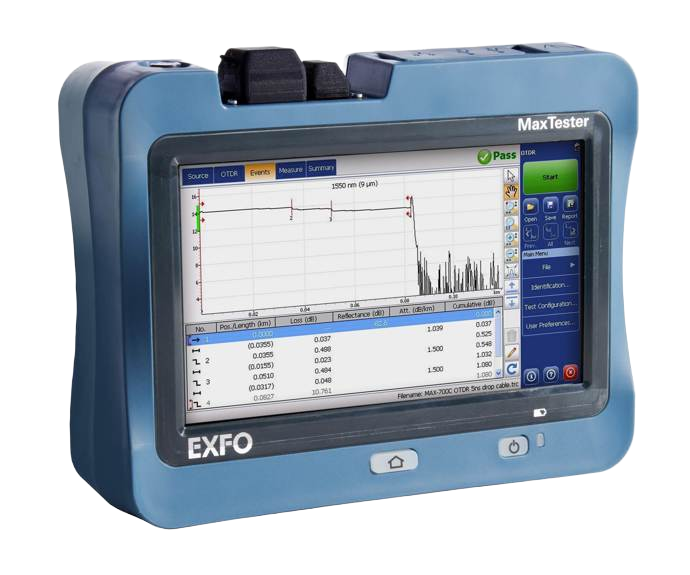
An OTDR is essentially a diagnostic instrument for optical fiber. It sends light pulses through the fiber and analyses the light reflected or scattered back. The resulting trace gives technicians information about what is happening along the link.
Therefore, an OTDR can help identify events such as splices, connectors, bends, breaks, and sections with unusual loss. It can also provide information about the distance to an event.
Think of a long fiber route running through a building, campus, or telecom network. If a fault occurs several kilometres into the link, physically checking every section would consume valuable time. An OTDR helps narrow the search by showing technicians where they need to investigate.
Why Does OTDR Selection Matter?
Not all fiber testing jobs are the same. A short enterprise link and a long telecom backbone cannot be automatically approached with the same test settings or equipment.
The wavelength needed, the distance of testing, the dynamic range, the type of connector, and the goals of measurement may vary significantly. In addition, the selection should be affected by the experience of the technicians who will be using the equipment.
This is why it is hardly ever the best idea to select an OTDR just because it is there. The first step that teams seeking to rent an OTDR in Dubai, UAE, should take is to determine what they need to measure.
Begin With the Fiber Network You Are Testing.
Know your network before choosing an OTDR.
Is it a single-mode or multimode fiber project? What is the length of the link? Do you test recently installed fiber, are you troubleshooting an existing fault, or are you documenting a network prior to handover? Does it have more than one connector and splice?
These questions instantly simplify the selection of equipment. As an example, a short local network is not as difficult to test as an event on a long-distance optical connection.
At ETS, we have a rental strategy that aims to assist our customers in finding the right test equipment based on the application rather than considering all projects as the same.
Take into account the Wavelength to be used in Testing.
Depending on the fiber and application, OTDR testing is usually done at certain wavelengths. Thus, one of the initial specifications that should be verified prior to renting equipment is wavelength capability.
Appropriate wavelength testing enables the technicians to test the behavior of the fiber in the conditions that are pertinent to the network. In other cases, multiple wavelength testing can also be used to identify problems that may not be as apparent in a single test.
Therefore, teams ought to verify the project requirements prior to equipment arriving at the site. By so doing, one will not waste precious working hours since the tester chosen does not accommodate the necessary test setup.
Look at Dynamic Range and Testing Distance
Dynamic range determines the maximum distance that an OTDR can test successfully and the ability to analyse events along a fiber link.
Does this imply that you just need to select the maximum dynamic range? Not necessarily.
Increased capability is only beneficial when it is needed by the application. A short fiber installation might not need the same instrumentation as a long-haul telecom network. The choice of equipment based on the real-life conditions of the project makes the rental viable and economical.
In the process of renting an OTDR in Dubai, UAE, teams are therefore advised to provide information regarding the approximate link distance and type of network. These facts assist in selecting a suitable testing solution.
Dead Zones: Do Not Ignore.
OTDR specifications like event dead zone and attenuation dead zone may be of special concern when events are near each other.
Suppose there are two connectors that are relatively close to each other. If the OTDR is not able to sufficiently differentiate closely spaced events, technicians might not get the detail necessary to analyze them properly.
This is particularly applicable in testing shorter links, patch panels, dense fiber environments, or networks with multiple connection points. Thus, OTDR selection must not only take into account the distance that the instrument can test but also the ability to differentiate events.
Test the Entire Testing Process.
A fiber work is seldom finished with a single instrument; an OTDR is important.
Depending on the project, installation and maintenance teams might need optical loss test sets, power meters, light sources, Ethernet testers, fiber certification equipment, or fusion splicing equipment.
This is where equipment planning becomes valuable. Instead of treating every instrument as a separate requirement, look at the complete workflow:
- Install or access the fiber.
- Splice the required sections.
- Inspect and verify the connections.
- Test optical performance.
- Locate unexpected events or losses.
- Record results for commissioning or handover.
Planning this sequence early helps teams determine what needs to be rented and for how long.
What If the Project Also Requires Fiber Splicing?
A fiber fault sometimes needs more than diagnosis. Once technicians locate a damaged or problematic section, they may need to repair and resplice the fiber.
For such assignments, combining OTDR access with Splicing machine rentals in Dubai UAE can make the workflow considerably more practical. The OTDR helps identify and verify events, while the fusion splicing machine supports the physical repair or installation work.
ETS provides fiber-related equipment solutions covering testing, splicing, installation, and certification requirements. Thus, telecom contractors can approach equipment rental as part of a broader fiber project rather than sourcing every tool independently.
Why Rent Instead of Purchasing an OTDR?
Buying equipment certainly makes sense for organisations using the same tester continuously. However, rental becomes attractive when demand changes from one project to another.
A contractor may need an OTDR for commissioning this month, an RF tester for another project, and different fiber equipment later. Owning every specialized instrument can tie up capital while also creating storage, maintenance, and equipment-management responsibilities.
ETS offers short-, medium-, and long-term rental plans and OPEX-oriented plans. This gives businesses a chance to better align equipment access to project duration and operational requirements.
Think Beyond the Rental Price.
One is tempted to compare OTDR rentals solely based on daily or monthly cost. Nevertheless, the lowest-cost instrument does not always mean the cheapest one to use in the project.
A slowdown of the troubleshooting process, replacement, or failure to provide the measurements required to document by the wrong tester can result in more downtime than the savings it was originally intended to provide.
Instead, teams need to take into account the equipment appropriateness, rental period, technical needs, availability, and access to knowledgeable support. When it comes to project-based telecom work, the correct equipment at the correct time may be more significant than the lowest headline rental rate.
Why Work with Empirical Testing Solutions?
Empirical Testing Solutions has over 17 years of experience in the industry in testing, measurement, telecom, and technology needs. Our customers are in the telecommunications, utilities, aerospace and defense, broadcasting, financial institutions, healthcare, and education industries.
Our portfolio extends beyond rental of OTDR in Dubai, UAE. ETS provides optical test equipment, RF and microwave equipment, electrical test equipment, fiber and copper certification equipment, splicing machines, cable blowing equipment, instrumentation equipment, and other professional testing equipment.
We also provide technical consultation and training to customers. In the case of fiber teams, this encompasses practical areas like fiber splicing, OTDR testing, link-loss testing, cable blowing, duct handling, and optical fiber cable practices.
Choose Equipment Around the Job, Not the Other Way Around
Successful fiber testing begins before the OTDR is switched on. Teams need to understand the network, expected distance, fiber type, wavelengths, required measurements, and the purpose of the final test report.
Once those factors are clear, renting becomes much more straightforward.
Whether you are commissioning new fiber, investigating an unexpected loss, maintaining an existing telecom network, or completing a project that also requires Splicing machine rentals in Dubai UAE, Empirical Testing Solutions can help you identify suitable equipment for the assignment.
Instead of investing in specialized instruments for every temporary requirement, talk to ETS about flexible test and measurement equipment rental options in Dubai and across the UAE. Get the equipment you need for the project, use it for the period required, and keep your team focused on what matters most: testing the network accurately and getting the fiber link ready for service.